Decolonizing Therapy, Introduction, Response Part 1
In October of 2025, I did a deep dive into African American identity and began studying the ways we express ourselves across a broad spectrum of creative forms. One form being fashion. My fashion research led me down a political and biblical rabbit hole that made me ask a deeper question: Who are we? The answer is complex because the more I studied, the more answers I found. For the purposes of responding to Decolonizing Therapy by Dr. Jennifer Mullan, I will say that, as a collective group of marginalized individuals, we are cultivators who are in need of each other’s company to support our existence.
I decided to pause that rabbit hole because it became heavy. I truly could not process everything I was learning at once, yet everything I studied from October through December feels deeply relevant to Dr. Mullan’s work. As a Clinical Counseling graduate student, it is important for me to take in information slowly and intentionally, laying my experiences alongside research, facts, and shared knowledge. Throughout graduate school, I have gone down many rabbit holes and uncovered histories that speak directly to the fabric of who we are. Doing that work within myself has given me a new perspective on colonialism, one that has improved my mental health and shaped the way I show up for others.
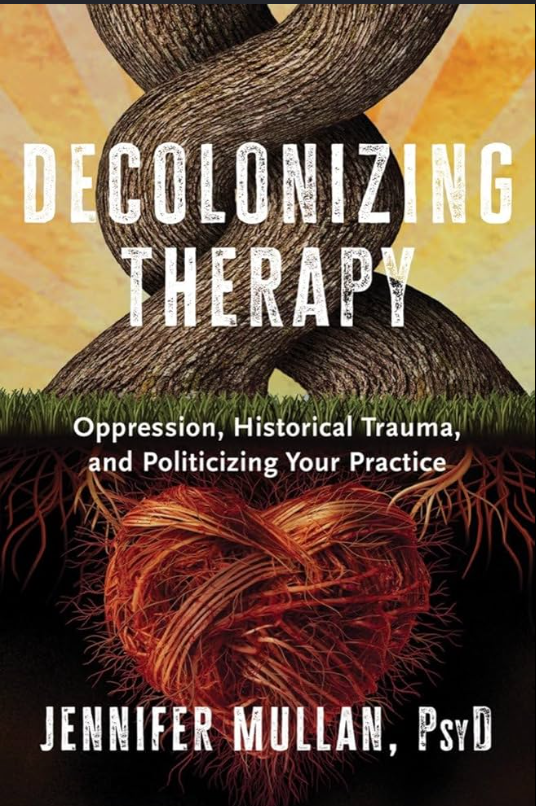
In this reflection, I will revisit what I was studying in October in a more linear way. Many of Dr. Mullan’s points mirror questions I was already asking myself. I feel in community with other BIPOC scholars who are unafraid to confront marginalization and professionalism head on. Dr. Mullan references a variety of intellectuals and their work, but to really get into the heart of this book, I want to expand on her ideas, ask additional questions, and invite those reading my blog to share their own thoughts. This work is pivotal to the mental health community because it asks us to stop embracing the Medical Industrial Complex — a health care system that profits from pain — and instead approach wellness, including counseling, as a sacred practice rooted in holding, loving, and honoring humanity rather than capitalizing on suffering.
Over the past seven months, I have taken back my autonomy as a health care provider. I have been intentional about setting boundaries and reclaiming my rest because these systems constantly demand more while giving less. At one point, I was doing so much that I neglected sleep, relied on matcha just to stay alert, and accepted a dysregulated nervous system as normal in order to “keep my job.” Dr. Mullan emphasizes the importance of not forcing sessions or practicing in coercive ways, and I no longer subscribe to that mindset. Working within systems often means hearing things like, “You have to complete a certain number of sessions each week,” and I once believed meeting those expectations made me a good counselor. In reality, I was moving toward burnout and reinforcing the Medical Industrial Complex. Today, I do what I can, when I can, with those who choose to engage. I value holding space, and holding space should always remain optional for both the person receiving care and the person providing it. Protecting autonomy matters. Protecting my autonomy and the autonomy of those I serve helps maintain balance and healthy boundaries. I cannot be a healthy practitioner if I am depleted trying to meet the expectations of a broken system.
Dr. Mullan also reminded me that I am not responsible for each individual outcome. To believe that one-on-one sessions alone can “fix” someone is inhumane. I no longer carry the emotional weight of everyone I work with. Instead, I see myself as a hub, a resource, someone who can help connect people to a village of healing rather than positioning myself as the entire village. There was a time when I felt guilt, doubt, and even depression because I could not provide solutions for everyone I supported. But I am not a magic fairy. I am a person, just like the person sitting across from me, and we are both learning through this human experience together. Earlier in my counseling journey, I carried an enormous amount of pressure because I could not “fix” problems, and management often pushed a one-size-fits-all approach to care. I was led to believe that selling hope without honesty was helping, but that guidance was misguided. I wish this book had been available to me before I took on my first client because it could have prevented a lot of sorrow. To anyone who has ever felt let down by me in my learning process, I offer a sincere apology.
At the heart of all of this is a simple realization: healing is collective, and so is accountability. This book has challenged me to rethink what it means to show up as a counselor, a student, and a human being navigating systems that were not built with all of us in mind. My hope is that this reflection opens a conversation rather than closes one. I am still learning, still unlearning, and still asking questions. If there is one thing I know for sure, it is that true wellness requires community, honesty, and the courage to pause long enough to listen — to ourselves, to each other, and to the histories that brought us here. As I continue this journey, I invite readers to reflect alongside me, challenge what feels uncomfortable, and imagine new ways of caring that center humanity over productivity, connection over performance, and healing over survival alone.
To continue reading the Decolonizing Therapy series, subscribe below.
As an Artisan, your support helps nurture a reflective art community rooted in intention, craft, and the quiet growth that defines Saged by Si.
